
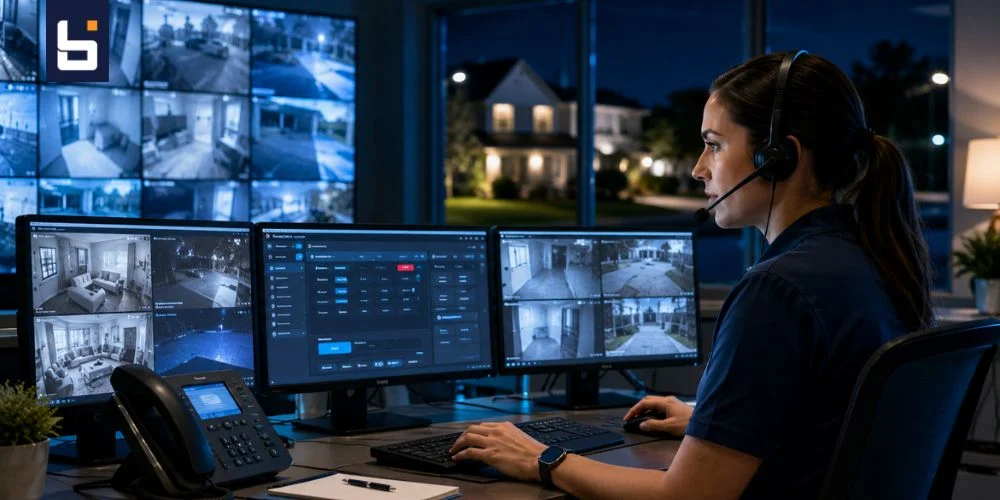
A homeowner’s alarm goes off at 2:14 a.m. Somewhere between 94% and 99% of the time, it turns out to be nothing. It might be a cat, a loose window, or a teenager sneaking in late. That comes from dispatch data compiled by Smart Security Concierge. That statistic explains why police response times average 36 minutes. It also explains why a home security answering service matters more than most companies realize. A generic call center can answer the phone, sure. However, it usually cannot tell a false alarm from a real emergency. It cannot calm a frightened homeowner or follow your exact escalation protocol. That distinction, subtle as it sounds, quietly decides whether you keep a customer or lose one.
Dispatch • Monitoring Team • Escalation
Billing • Appointment • Technical Support
Why a Home Security Answering Service Solves a Different Problem Than a Call Center
Traditional call centers are built for volume, not nuance. They typically rely on generalized scripts, which stretch calls out to ten or fifteen minutes. That finding comes from comparison research by MightyCall. A dedicated answering service trains agents specifically on your business instead. As a result, they usually resolve calls in under ninety seconds. They never sound like they are reading from a manual. For an alarm company, that speed is not a nice bonus; it is the entire point. Homeowners calling about a triggered sensor at midnight are not in the mood for hold music. They will not wait patiently while an untrained agent searches for your verification steps.
Alarm Company Call Handling: The Moment Scripts Break Down and Trust Breaks With Them
Alarm calls are unlike almost any other customer service interaction. The caller is sometimes genuinely frightened and needs quick, confident guidance. A polished sales pitch will not cut it here. Alarm company call handling has to account for verified response laws and false alarm fatigue among dispatchers. It also has to account for the real chance that a call is not routine at all. As customer experience expert Shep Hyken put it, “Customers don’t just want service, they want confidence in their decision.” That line applies directly to a homeowner deciding whether to trust your brand again. A generic agent working across a dozen unrelated industries cannot deliver that confidence. Familiarity with your exact protocols simply cannot be faked at 2 a.m.
Security System Customer Support Outsourcing Is About More Than Missed Calls
It is tempting to think security system customer support outsourcing exists purely to stop voicemail overflow. That matters, but the bigger issue is consistency. Roughly 85% of callers who reach a busy signal never call back. That figure comes from missed-call research cited by Bland AI. That single statistic turns a routine question into a permanently lost customer. However, consistency matters just as much as availability. A homeowner who gets a warm agent on Tuesday, then a scripted stranger on Saturday, starts wondering. What else about the service is inconsistent? Trained answering service agents adopt your company’s voice thoroughly. Most callers never even realize they reached a third party at all.
Monitoring Center Overflow Calls Cost More Than Most Alarm Companies Realize
Monitoring center overflow calls tend to spike exactly when things go wrong everywhere at once. A storm knocks out power across a neighborhood, and dozens of alarms trigger simultaneously. Your in-house team suddenly cannot keep pace. Meanwhile, every unanswered call during that surge quietly teaches customers to distrust the system. Missed calls already cost U.S. service businesses more than $126,000 annually on average. That figure only counts the calls that never connected at all. An answering service built specifically for overflow absorbs that surge instantly. It routes routine questions away from your monitoring specialists. That frees them to focus on verifying real emergencies instead of explaining billing cycles.
A Real Example Worth Studying: What Happens When Response Actually Improves
ADT’s own internal optimization work offers a useful illustration of this principle. ADT’s efforts to reduce response times meaningfully increased appointment booking rates. That finding comes from Boomsourcing’s research on home security contact centers. The underlying logic scales down easily to smaller alarm companies. Faster, more consistent human response builds trust that keeps customers renewing. Otherwise, they tend to shop around after a single bad experience. Verification technology alone reduces false alarms by roughly 95%, according to research summarized by Deep Sentinel. Even the best verification system still needs a human voice on the phone. That voice reassures a homeowner that someone is actually paying attention.
Building a Security Brand That Homeowners Actually Trust
None of this requires an expensive overhaul of your monitoring infrastructure. It requires recognizing that an answering service and a monitoring center solve different problems. People often confuse the two, even though they rarely overlap. The monitoring center verifies threats and dispatches help. The answering service, meanwhile, handles the surrounding conversation. That includes billing questions, appointment requests, and storm-driven overflow. It also includes the reassuring voice that greets someone who forgot their own code. Alarm companies that treat these as separate, equally important functions retain customers longer. Every touchpoint reinforces the same message: someone is always listening.
There is also a quieter financial argument here that gets overlooked. The U.S. alarm monitoring services market is projected to reach $12.4 billion by 2028. That figure comes from alarm industry statistics compiled by Gitnux. It is growing at nearly 6% annually. Every competitor chasing that growth is fighting for the same homeowners. Many of them compare providers based on reviews about call handling, not just equipment specs. A missed call or a cold, scripted interaction shows up in those reviews eventually. Unlike a false alarm, a bad review rarely gets forgotten. It sits on Google for years, quietly steering the next homeowner elsewhere.
A Quick Word on the Humor in All This
There is something almost funny about this industry’s blind spot. It is built entirely on trust and vigilance, yet many still route customers to whoever happens to be free. Alarm companies spend heavily on sensors and AI-powered verification. That technology can catch a burglar in under a second. Meanwhile, a worried customer sits on hold listening to elevator music. If a security system can tell a raccoon from an intruder, a phone system should manage something simpler. It should tell an emergency from a billing question. That mismatch is usually the clearest sign it’s time to separate the two functions.
Ready to Stop Losing Homeowners to Voicemail and Scripts?
If your alarm company routes every call through one generic queue, you are asking too much of your team. You are also asking too much of your customers’ patience. Boomsourcing’s answering services team specializes in exactly this kind of security-focused call handling. Agents are trained specifically on the home security industry, not borrowed from unrelated verticals. Pair that with Boomsourcing’s alarm systems lead generation support for full-funnel coverage. Every inbound call, whether it’s an emergency or a billing question at 3 a.m., gets handled properly. Reach out to Boomsourcing today, and give every homeowner the confident, human response their safety deserves.


 Connect WITH US

 By Tom Berg
 By Nathan Brown
 By Rajesh Adhikary