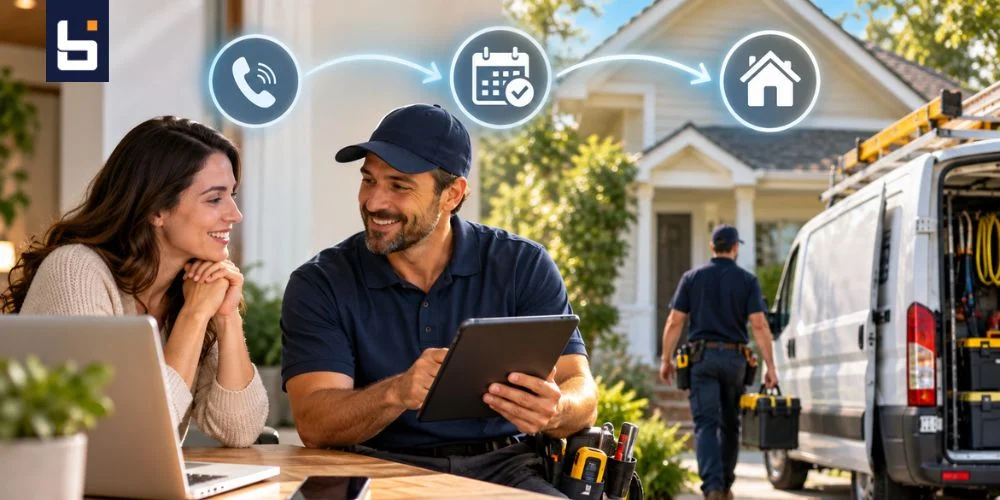
Home services lead conversion often breaks down after an inquiry has already reached the business. A homeowner calls, submits a form, responds to an ad, or requests information. What happens next determines whether that interest becomes a conversation, a qualified appointment, or another opportunity that quietly disappears.
For home service companies, generating demand is only part of the job. Response time, qualification, scheduling, confirmation, and the eventual sales handoff all influence how much value the business gets from the leads it already has.
This distinction matters because adding more leads does not automatically produce more revenue. If inquiries are sitting unanswered or qualified prospects are not being booked, increasing marketing spend can simply increase the amount of demand that leaks from the funnel. We explored that broader problem in why more leads do not always mean more revenue.
Home Services Lead Conversion Starts After the Inquiry Arrives
Homeowners may discover a contractor through search, referrals, marketplaces, local listings, advertising, organic traffic, or an existing customer relationship. Regardless of where the inquiry comes from, the operating question is the same: what happens once somebody raises their hand?
A useful lead response process should quickly establish what the customer needs and what the right next step should be. That could mean scheduling an estimate, booking a service visit, arranging a consultation, qualifying the homeowner for a specific service, or moving a sales-ready prospect directly to the appropriate team.
This is where the difference between home services lead generation and conversion becomes important. Lead generation creates the opportunity. The operating process that follows determines how much of that opportunity actually progresses toward a booked job.
A Practical First-15-Minute Lead Response Framework
The exact timing will vary by service category, staffing model, urgency, and lead source. However, the sequence below gives home service businesses a useful way to think about the first few minutes after a high-intent inquiry arrives.
| Stage | What Should Happen | Business Objective |
|---|---|---|
| 0:00 Lead Arrives |
A call, form, referral, marketplace inquiry, or campaign response enters the business. | Make the inquiry visible and assign ownership immediately. |
| First Few Minutes Respond |
Answer the call or begin follow-up while the homeowner’s need is still current. | Create contact before intent cools or the homeowner moves to another provider. |
| Next Qualify |
Confirm the service needed, location, urgency, availability, and other business-specific qualification criteria. | Identify whether the inquiry should move forward and to which team. |
| Then Book or Transfer |
Schedule the right appointment or connect a sales-ready prospect to the appropriate person. | Turn qualified intent into a concrete sales opportunity. |
| Before Handoff Confirm |
Capture accurate details, set expectations, confirm the next step, and transfer relevant context. | Reduce friction between initial contact and the sales or field team. |
1. Respond While the Homeowner’s Intent Is Still Active
Many homeowners contact more than one provider. They may be comparing availability, service areas, estimates, response times, or simply who can solve the problem soonest. An inquiry that waits too long may still exist in the CRM, but the commercial opportunity may already have shifted elsewhere.
For phone-based demand, call answering services can help businesses maintain coverage when internal teams cannot consistently answer every inbound call. The purpose should go beyond taking a message. The conversation should capture why the customer called and move the inquiry toward the correct next action.
Coverage becomes even more important outside standard business hours. HVAC failures, roof leaks, electrical issues, security concerns, and other home service needs do not follow an office schedule. A structured after-hours call handling strategy for home services can help businesses avoid leaving valuable inquiries untouched until the next day.
Strong home service lead follow-up therefore requires clear ownership across live calls, missed calls, web inquiries, and any other channels that feed demand into the business.
2. Qualify the Inquiry Before It Consumes Sales Capacity
Fast response matters, but speed without structure can simply push more unfiltered inquiries toward sales. Effective lead qualification services help determine whether an inquiry meets the criteria defined by the business. Depending on the home service category, that may involve confirming ZIP code, service area, project type, urgency, property characteristics, availability, product interest, or another program-specific requirement.
This form of inbound lead qualification can be especially useful when estimators, field representatives, or sales specialists are expensive resources. Their time is better spent speaking with prospects who already pass the first level of screening.
Qualification should also create useful context. When a prospect reaches the next person, that team should already understand why the homeowner contacted the company and what has been established so far. Our guide to lead validation and qualification outsourcing looks more closely at how businesses can structure this stage before leads reach the sales team.
3. Make Booking the Next Step, Not Another Follow-Up Task
A qualified homeowner is not yet a booked job. Between qualification and the eventual sale sits another important conversion point: securing the next action.
For many contractors, this means an estimate, inspection, consultation, demonstration, or service appointment. Appointment setting services can help move qualified prospects into available slots instead of leaving them in an open follow-up queue. This is why businesses should look beyond simple lead volume and monitor lead-to-appointment conversion. If qualification rates are healthy but too few qualified leads become appointments, the bottleneck is no longer at the top of the funnel.
The speed of that transition matters as well. Our article on how speed-to-appointment turns qualified leads into sales opportunities explores why the time between qualification and booking deserves attention of its own.
38% of calls answered by a person are leads, and 45% of those leads convert on the call. Those 2026 home-services benchmarks from Invoca illustrate why the quality of the interaction after somebody answers can matter as much as getting the phone to ring.
Source: Invoca, 2026 Home Services Lead Conversion Benchmarks Report
4. Find Where Qualified Demand Is Leaking
Lead leakage is rarely one isolated problem. It usually happens through small breaks between marketing, customer contact, qualification, scheduling, and sales.
An unanswered call is one leak. A qualified homeowner who never gets scheduled is another. An appointment booked with incomplete information can create another problem downstream. Improving home services lead conversion requires visibility across the entire journey, not optimizing each stage independently.
Where Home Service Opportunities Commonly Break Down
| Lead Stage | What Can Go Wrong | What a Better Process Looks Like |
|---|---|---|
| Lead Arrives | The phone is not answered, or digital follow-up begins too late. | Defined response ownership and live answering coverage where required. |
| First Contact | Salespeople spend time screening inquiries that do not meet basic criteria. | Structured inbound lead qualification before sales handoff. |
| Qualification | A good prospect is identified, but no appointment or next action is secured. | A clear appointment-setting or live-transfer path. |
| Pre-Appointment | Information is incomplete, or the customer is unclear about what happens next. | Accurate appointment confirmation and clear expectations. |
| Sales Handoff | The customer has to repeat information because context is lost between teams. | A structured handoff with qualification details and interaction history. |
5. Use the Right Handoff for the Right Prospect
Not every qualified lead should follow the same path. Scheduling a consultation is the best way to engage a homeowner who is researching a future remodeling project. A prospect calling with an immediate need may require a service appointment. Another high-intent customer may already be ready to speak directly with sales. For the last group, waiting unnecessarily for a later callback can introduce another point of friction. A live transfer can connect a qualified prospect with the right person while the conversation is still active.
Our comparison of live call transfers versus traditional leads explains how these approaches differ and why the appropriate handoff depends on the prospect’s readiness. Whatever method is used, a good sales handoff should preserve context. The next representative should know what service the homeowner wants, what has already been discussed, whether the lead meets qualification criteria, and what outcome the customer expects.
6. Measure More Than the Number of Leads
Lead count is useful, but it does not explain whether the conversion process is working. Home service businesses should consider tracking the stages that move demand toward revenue. Depending on the operating model, useful measures may include answer rate, contact rate, qualification rate, booking rate, lead-to-appointment conversion, appointment confirmation rate, no-show rate, live-transfer rate, and the percentage of qualified opportunities that become customers. These measures help leadership identify where the real constraint sits.
If answer rates are weak, the problem may be coverage. Furthermore, if many leads are contacted but few qualify, marketing or targeting may need review. If qualified leads are not booking, scheduling or follow-up may be the issue. Besides, if booked appointments are strong but sales remain weak, the problem may sit further downstream. That is a more useful conversation than simply asking marketing to generate additional volume.
When Should a Home Service Business Consider Outsourcing?
Outsourcing can make sense when inbound demand regularly exceeds internal capacity, calls are missed during busy periods, follow-up is inconsistent, sales teams spend too much time screening inquiries, or appointment coverage cannot scale with seasonal demand.
The strongest model does not outsource activity simply for the sake of outsourcing it. It assigns repeatable stages of the conversion journey to a team designed to execute them consistently while internal specialists remain focused on closing, field operations, technical work, or other higher-value activities. That may involve combining lead qualification services with appointment setting services, inbound call handling, follow-up, and structured handoffs.
For larger or multi-location operators, Boomsourcing’s home services support capabilities can connect these stages within a broader operating model. Its customer acquisition services can also support the journey from initial customer interest to a qualified sales opportunity.
More Leads Are Not the Only Route to More Booked Jobs
Home service companies already invest heavily in creating demand. The next opportunity is often not simply to generate more inquiries, but to improve what happens to the inquiries already entering the business. A strong conversion process has a straightforward logic: respond, qualify, book or transfer, confirm, and hand off with context.
When each stage has clear ownership and measurable standards, home services lead conversion becomes easier to diagnose and improve. More qualified appointments and booked jobs can then come from better execution across the existing funnel rather than relying only on additional top-of-funnel volume.
Turn More Home Service Inquiries Into Sales Opportunities
Boomsourcing helps home service organizations support the stages between initial inquiry and customer acquisition through call handling, lead qualification, appointment setting, follow-up, and scalable customer engagement operations.
If your business is generating demand but losing opportunities between first contact and booking, the first question may not be how to generate more leads. It may be where the existing conversion process is breaking down. Talk to Boomsourcing about your lead conversion process.


 Connect WITH US


 By Edgar Sainz
 By Rajesh Adhikary

 By Nathan Brown